
參賽序號:2-11
海報主題
Mapping Molecular Clump Kinematics via Velocity and Intensity Gradients in Panta Rei
系級
物理系
指導老師及參賽學生
指導老師:Seamus Clarke (凱嘉煒)
參賽學生:許家輝
構想說明
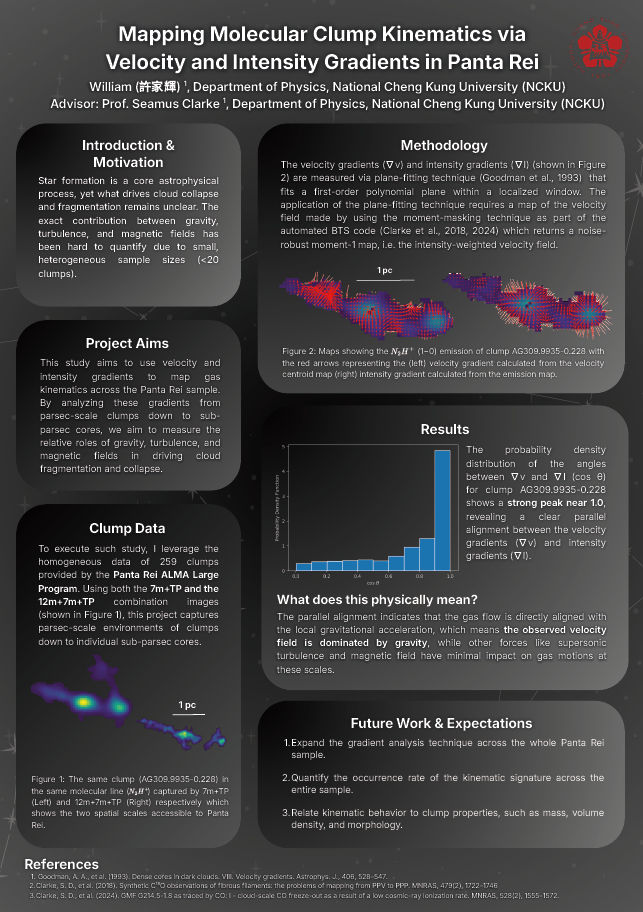
Understanding the physical mechanism that drives the collapse and fragmentation ofdense clouds into protostars is crucial for understanding stellar formation processes. Determining the exact energetic ratio between gravity, supersonic turbulence, and magneticfields has been historically limited to small and heterogeneous samples. Using data providedby the Panta Rei ALMA Large Program, I will perform a kinematic gradient analysis across259 molecular clumps.
Using the N2H+ (1-0) molecular line data, we map local velocity fields and emissionintensities. Applying localized linear plane-fitting algorithms via Python, we derive localvelocity gradients (∇v) to trace gas flows and local intensity gradients (∇I) as proxies forlocal gravitational acceleration.
Pilot implementation on the example clump AG309.9935-0.228 demonstrates the pipeline in mapping the gas flow. To determine the dominant physics governing these regions,we evaluate vector alignments between gas flows and gravitational acceleration ((∇v ⋅ ∇I),and between gas flows overall clump elongation (∇v ⋅ Eaxis). Alignment between velocityand intensity gradients tell us that local gravitational collapse drives gas dynamics.
In contrast,random or disordered gradient distributions signal turbulence-dominated kinematics.
Furthermore, velocity gradients oriented perpendicular to clump elongation axes reveal gas flows constrained along magnetic field lines. Finally, binning the sample by their luminosity-to-mass (L/M) ratios yield how these kinematic and energetic signatures evolve over time.
-
分享:


 115年活動熱烈報名中!